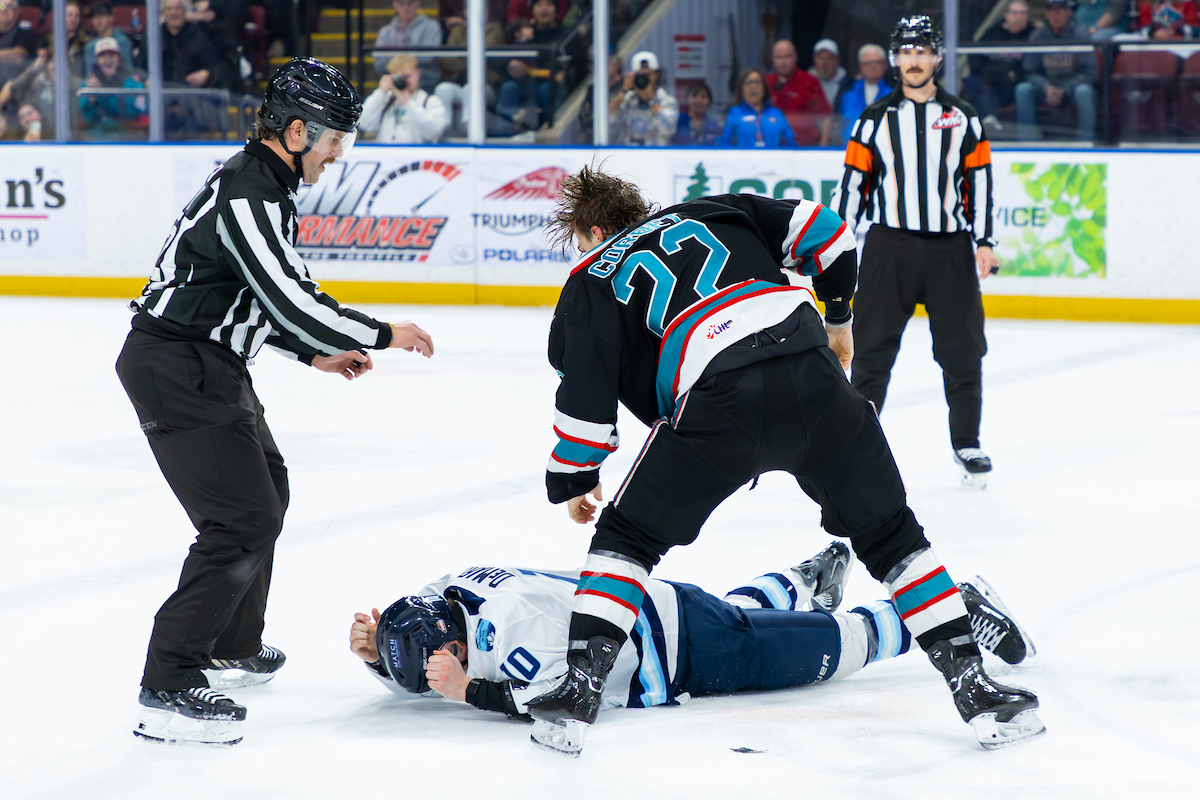
Nate Corbet in a fight last season against Penticton (Image Credit: Steve Dunsmoor)
The art of self-preservation

Formidable fist thrower

Nov 3, 2026 | 7:49 AM

Nate Corbet knows how to fight.

He has 40 over his WHL career, including regular season, postseason, and the 2026 Memorial Cup.

He also knows he probably shouldn’t tell you exactly how he does it.

The Kelowna Rockets defenseman has turned fighting into a real skill, not simply something he does when emotions boil over. He watches other fighters. He asks questions. He studies what happens when a fight goes well and what happens when it doesn’t.

There is technique involved. There is timing. There is reading an opponent.

And Corbet apparently keeps a few secrets to himself.

“I kind of love the art of fighting,” he said. “I’ve obviously fought a little bit, but I’m kind of obsessed with the art of fighting.”

Corbet’s interest in the craft started when he was 17. At first, he was almost treating it like a challenge, setting a goal for himself and seeing where it took him.

“I kind of started with, ‘OK, I maybe want five fights this year,’ when I was 17,” he said. “Then when I got to five fights, maybe in my mind I was like, ‘Oh, that was a quick one, doesn’t count.’ Then I needed to make up for it.”

Eventually, he realized fighting could become another part of his game.

“I realized this is kind of a part of my game that maybe, I’m not scoring goals, but I think I can bring this,” Corbet said. “That’s an intimidating factor. I want to be a hard player to play against.”

But Corbet didn’t just decide to fight more. He started learning how to fight better.

When he sees an experienced fighter, he wants to talk about it. When he watches someone else’s fight, he wants to know what the fighter was thinking.

“Anytime there’s kind of a tough guy, I guess you could say, I always try to talk shop with him and learn things from him,” he said. “Or I see guys have their fights, so like, ‘What do you think of? What were you thinking here? When you’re in trouble or when you’re dominating here?’”

That curiosity has helped turn fighting into something Corbet studies almost like a player would study a power play or a defensive system.

He learned from fighters on the ice. He watches fights. He has worked with a fighting coach in Los Angeles.

And when he describes what happens during a fight, it becomes clear there is more going on than simply throwing punches.

At last year’s Memorial Cup, Corbet realized almost immediately that his opponent was a left-hander.

“As soon as I realized he was a lefty, I realized he was throwing a little quicker than I was with my rights,” he said. “So I tried to defend myself, get my arm up and take a second to regroup.”

Then he adjusted.

“There is a little bit of thinking and method to the madness, feeling the body movements and then being able to counter from there,” he said.

And then comes the part where Corbet sounds a little like a chef being asked for his signature recipe.

“Don’t want to reveal too many of my secrets,” he said.

Fair enough.

There is a reason Corbet doesn’t want fighting to become the only thing people see when they watch him play.

“Some people are, ‘Oh, he’s a fighter,’” he said. “I don’t really like the word fighter because I feel like it just limits you to that’s all you can do.”

He wants his game to be about much more than that.

“I want to be known for my defence and playing hard, and obviously sticking up for teammates is a big one,” he said. “Being able to move the puck and play fast. I don’t want to be known as just a fighter. That’s just too limiting.”

The fighting is simply one more tool.

And it is a tool Corbet has taken seriously enough to understand that there are risks involved.

He knows what can happen when two players drop their gloves. He has seen players get knocked out. He knows a fight can change quickly.

“Sometimes,” Corbet said when asked if he is ever scared.

He understands that thinking about a fight before it happens can be worse than the fight itself.

“When you think about it for a little bit, like it might happen tonight, it might not, and that can kind of get to you,” he said. “But the illusion is always greater than what it actually is usually.”

That is why technique and self-preservation have become such a big part of his approach.

“I just like to build my base and obviously technique,” he said. “Just to be able to self-preserve. We call it self-preservation.”

Corbet said the fighting coach in Los Angeles has helped him with that part of his game, including his base and footwork.

“Having the base with your feet, kind of, so you’re not in a position to experience the greatest consequence in a fight, which is getting knocked out,” he said.

For all the attention his fights can bring, Corbet doesn’t see himself as someone who simply wants to fight.

He wants to be a difficult player to play against in every part of the game.

There is still room for the fighting, though.

“Bring an aspect and element that not a lot of guys do,” Corbet said. “For me, maybe that’s fighting, maybe that’s playing hard.”

Maybe that’s the best way to understand Corbet’s approach.

He isn’t trying to be known as the guy who fights.

He’s trying to be the guy who can do a lot of things, with fighting being one of the things he happens to do particularly well.

Just don’t expect him to hand over the recipe.

Comments

Leave a Reply