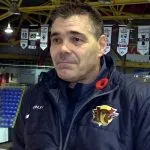
A father’s fear, community response to T

‘People Are Genuinely Good’ – Todd Halaburda

Apr 22, 2026 | 6:00 AM

It is a game the Halaburda family will not soon forget.

Saturday, April 11th, began like so many others. Todd Halaburda and his wife, Tina, were at home in Victoria, watching the webcast as their son, Ty, a 20-year-old forward with the Kelowna Rockets, played Game 2 of a second-round playoff series against the Everett Silvertips.

Then, in an instant, everything changed.

Ty went down following a hit and did not get up.

“It didn’t take long for me to figure out that it was Ty,” Todd told RocketFAN. “You go into a whole other frame of mind.”

Watching from home, there was no information. Only images.

“I was literally eight inches away from our TV,” he said. “You’re almost going into full prayer mode, hoping everything’s going to be good.”

As medical staff rushed onto the ice, the silence stretched. For Todd, the wait felt endless.

“You’re just waiting to see him move,” he said. “You think the worst. You think spinal injury. You’re just waiting to see a leg or an arm move.”

Help, however, had already arrived.

One of the first people at Ty’s side was rookie forward Tomas Poletin, who dropped to a knee and stayed with him.

“When you go back and look at it, what stuck out is his teammate kneeling right beside him,” Todd said. “You could see he truly cared.”

Moments later, trained medical staff took control.

Kelowna Rockets athletic therapist Scott Hoyer was among those attending to Ty on the ice. His role, Todd later learned, was critical in those first few minutes.

“Scott’s biggest thing that he expressed to me was just making sure he was breathing,” Todd said. “He said Ty was out for about three to four minutes.”

In a moment where panic could easily take over, Todd was struck by the composure.

“For him [Hoyer] to be composed, it’s obviously part of his job, but it’s more than that,” he said. “We’re extremely grateful.”

Still, for several minutes, the Halaburda family had no update.

Then came a phone call.

Teammate Peyton Kettles, a scratch that night but near the glass where Ty lay motionless, reached out directly, delivering the first real piece of relief.

“He was the one who told us his eyes were open and he could move his arms and legs,” Todd said. “That was our first relief. I don’t think he realizes how important that call was.”

Hear the entire interview with Todd Halaburda by pressing play:

Back in Everett, Ty was transported to the hospital, where doctors quickly began their work. A CT scan revealed a skull fracture and a small brain bleed. Serious injuries, but ones that could be managed without immediate surgery.

Through it all, Ty was not alone.

His former billet family with the Vancouver Giants, already in attendance at the game, made their way to the hospital and stayed with him through the night.

“They made their way to the hospital and stayed with Ty all night,” Todd said. “She was literally in the ICU with him, right by his bedside.”

The communication never stopped.

“All night long, Tina’s not sleeping, she’s just texting back and forth,” he said.

By the time Todd and Tina arrived the next morning, they already had a sense of cautious relief. They had even seen their son the night before, thanks to technology.

“We did a FaceTime that night,” Todd said. “He was able to communicate really well. Maybe his speech was a little slurred, but all things considered, we were grateful.”

As the situation stabilized, support began pouring in from all directions.

The Everett Silvertips organization stepped in immediately, offering to cover expenses and making sure the family was taken care of. Team staff visited Ty in the hospital, showing support that went beyond the game.

The Kelowna Rockets did the same.

“[Rockets GM] Bruce Hamilton called us Sunday morning directly,” Todd said. “Whatever you need, we want to look after everything.”

Todd admits he had heard a reputation before that call.

“I’ve been told Bruce Hamilton is very intimidating,” he said. “I didn’t see that. I saw a very compassionate and really supportive man.”

Even WHL Commissioner Dan Near reached out in the days that followed.

“He was checking up on Ty and asking my perspective,” Todd said. “They’re looking at it like, is there something we could do better?”

For Todd, that mattered.

“I do believe they [WHL] have the support and the care for these players,” he said. “Sometimes it takes an incident like this to really see it.”

The hospital care itself also stood out.

“We were told you’re kind of lucky it happened there [Everett],” Todd said. “Probably some of the best care you’re going to get.”

Just days later, Ty was released and able to return home to Victoria.

Now, his recovery has a simple focus. Rest.

“He just sleeps,” Todd said. “His body will just tell him it’s time to sleep.”

There are encouraging signs each day.

“Every morning you can tell he’s better than the last day,” he said. “He’s sharp. He’s the same version of Ty.”

That, more than anything, has defined the outcome.

“I think a lot of people want to know what he’s like,” Todd said. “But he’s the same. Nothing’s changed.”

Ty will not return to play this season. With a skull fracture, that decision rests with doctors and leaves no room for risk.

But from the family’s perspective, that is a trade they would accept every time.

“When we were watching him on the ice, this is the best-case scenario,” Todd said.

Looking back, what stands out most is not just the injury, but the response.

“It’s incredible,” Todd said. “It does give you a whole new outlook. People are genuinely good.”

In a moment that quickly turned serious, that is what the Halaburda family will remember most.

Not just what happened.

But how everyone responded.

Comments

Leave a Reply