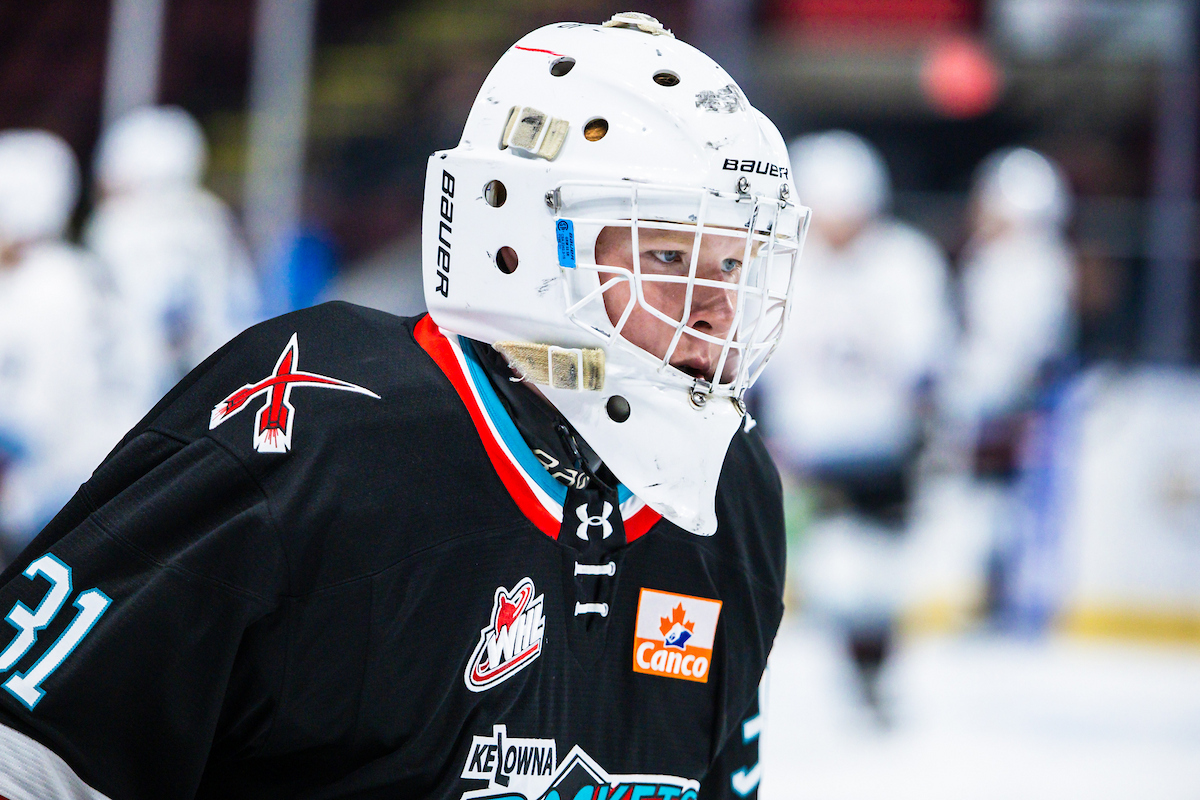
Linden Sobocan (Image Credit: Steve Dunsmoor)
Rookie goalie Linden Sobocan

Learning the ropes, one save at a time

Nov 6, 2026 | 7:00 AM

There are a lot of things a young goaltender looks forward to when making the jump to the Western Hockey League.

More starts. More responsibility. Better competition. And, apparently, a new set of equipment can make the whole experience even sweeter.

For Kelowna Rockets goaltender Linden Sobocan, the arrival of a new mask, pads, glove and blocker is something he’s already counting down the days to.

“I think my helmet, pads, glove and blocker are going to come in around the same time. If they all come in on the same day, that will probably be the best day of my life.”

It’s an exciting time for the young goaltender, who is settling into his first full season in the Western Hockey League.

Sobocan got a brief taste of the WHL last season, making his way into the Rockets dressing room and getting an opportunity to experience life around a team that was loaded with older players and considerable experience.

It was a valuable introduction.

“It was pretty sweet, getting to come up with a lot of the older guys,” Sobocan said. “Last year’s team was pretty old. There were a lot of guys with experience, including several NHL players. Getting to come up with them, gain that experience and play a game was awesome.”

What stood out wasn’t necessarily the speed of the game or the quality of the shooters. It was the work that went into being a Western Hockey League player.

Sobocan quickly discovered that making the jump to the WHL meant adjusting to a different level of commitment.

“You learn a lot about the maturity these guys have and how hard they’re working every day,” he said. “In under-18, a lot of guys are practicing for an hour or an hour and a half. In the Dub, every guy is working for two hours every day, and you’re working out too. Everything is about the grind.”

That grind is now part of his daily routine.

There is, however, another adjustment.

For the first time in his hockey career, Sobocan finds himself in a backup role.

“I’ve never been a backup,” he said when asked if he had ever found himself in this position before.

“You’re just staying ready and trying to make the most of every opportunity. I’m trying to learn as much as possible.”

Being a backup doesn’t mean being a spectator.

Sobocan is learning that there are plenty of ways to contribute, even when his name isn’t on the starting lineup.

“Even in games when I’m not starting, I’m trying to do everything I can to help the team, whether that’s talking on the bench, keeping the boys up or making sure I’m always ready,” he said. “It’s a different experience, but you have to make the most of it and make your opportunities count.”

One of the biggest benefits of being around the Rockets every day is having a front-row seat to watch Harrison Boettiger.

Sobocan has taken notice of what the older goaltender brings to the position, particularly his skating and ability to find the right position before a shot arrives.

“His movement is incredible. His skating is really good,” Sobocan said. “He’s always trying to get into the best position possible, and his tracking of the puck is excellent. Those are two parts of his game I’ve really been trying to learn from.”

A self-described Toronto Maple Leafs fan, Sobocan pays attention to goaltenders throughout the NHL, looking for little things he can add to his own game.

He keeps an eye on Anthony Stolarz and Sergei Bobrovsky, while New Jersey’s Connor Hellebuyck is another goaltender he studies.

There is also a young netminder making an impression in Montreal.

Sobocan likes what he sees from Canadiens goaltender Jacob Fowler, particularly his ability to remain composed when things get hectic around the crease.

“He’s a young guy who’s making the most of his opportunities,” Sobocan said. “I’ve been trying to pick up some of his techniques, particularly the way he stays calm in panicky situations. That helps him come up with saves.”

Sobocan believes composure is becoming an increasingly important part of his own development.

“I think I understand my size,” he said. “I’m a bigger goalie, so I can use that to my advantage when players are shooting. I can take up space and block shots.”

He also likes the progress he’s making when things get messy.

“In tight situations, when things get hectic, I think my ability to stay calm and get to where I need to be is getting pretty good.”

Of course, playing goal also means accepting that not every shot is going to be stopped.

There will be the occasional bad goal, the kind that leaves a goaltender wondering how a puck ever found its way past him.

Sobocan has an interesting way of dealing with those moments.

“One thing I sometimes do is look up and smile,” he said. “You just think, I’m playing a game right now. I can’t be worrying about something like that.”

There is a maturity to that approach.

“You can’t go back and change the past, no matter how badly you want to,” he said. “You just have to learn from it and move on. You have to tell yourself you’re going to make the next one because you need that self-confidence.”

It’s a lesson he continues to develop, both through experience and conversations with older players and coaches.

He has also come to appreciate that the mental side of goaltending can be just as important as the physical side.

“Your mental space has to be right. No matter how well you’re playing physically, if you’re not in the right mindset, it’s not going to go well,” Sobocan said. “You have to let your body do the work and let your mind almost zone out.”

And while game action is obviously the ultimate test, Sobocan doesn’t underestimate what can be learned in practice.

“You’re working hard in practice, and you get to know your shooters and what they’re working on,” he said. “You can learn what forwards are trying to do when they’re shooting and what they’re looking for. That teaches you what you need to do to make those saves.”

He also understands that the coaching staff is paying attention.

“You’re trying to make the most of every practice, every smaller game and every drill,” he said.

“Coaches notice those things. If you’re doing it in practice, you’re going to get more opportunities in games.”

Comments

Leave a Reply