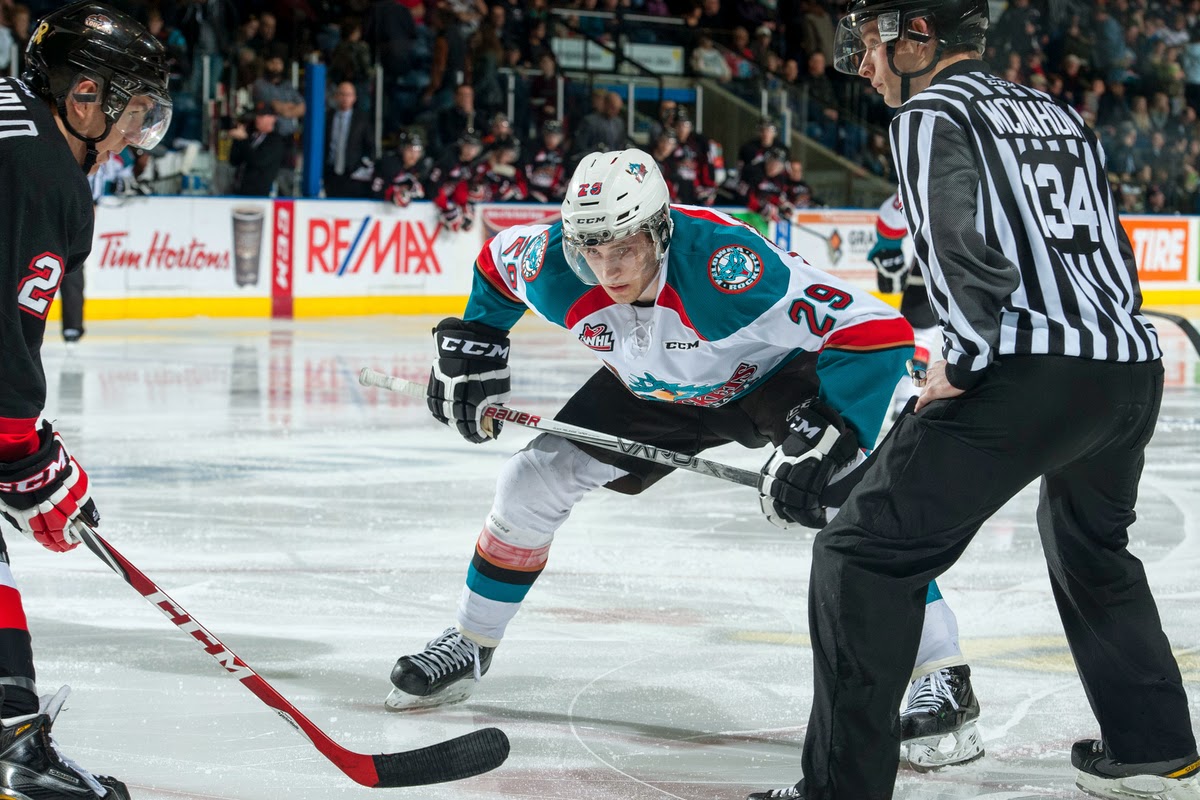
Leon Draisaitl in 2015 vs. P.G Cougars (Image Credit: Marissa Baecker)
A lesson in leadership

Leon Draisaitl wouldn’t give up his cellphone

Oct 9, 2026 | 7:01 AM

Leon Draisaitl wasn’t giving up his cellphone.

Not for Travis Crickard. Not in Prince George. And certainly not simply because the Rockets coaching staff told him to.

It was one of those small moments that probably meant little at the time.

Looking back now, with Draisaitl established as one of the NHL’s biggest stars, it says something about the player he was long before he became the player everyone knows today.

And Crickard had a front-row seat.

A decade after serving as an assistant coach with the Kelowna Rockets, Crickard was back at Prospera Place this week as the Swift Current Broncos made their way through British Columbia on a road trip through the B.C. Division.

His role has changed considerably.

Crickard is now the Broncos’ general manager and head coach.

But sitting underneath the 2015 WHL championship banner, his memories quickly went back to the Rockets team he helped coach, a group that included a young Draisaitl.

Crickard remembers walking around the pregame meal collecting the players’ phones. It was a Rockets tradition on the road, designed to get everyone away from distractions and focused on the game.

Then he got to Draisaitl.

The young German forward wasn’t convinced there was any reason his phone should be taken away.

“Why? Like, you don’t take our phones from us at home games. Why do you take them on the road?”

Crickard remembers trying to explain that it was simply a team rule.

“Well, no, you have to. Well, hey, like it’s what the team does. Like, can you do it today? And then maybe we can address it after.”

Draisaitl eventually handed it over.

But he made it clear the conversation wasn’t finished.

“I will be addressing this.”

And he did.

When the Rockets returned to Kelowna, Draisaitl walked into the coaches’ office.

“Coaches, you guys aren’t taking our phones anymore on the road.”

There was more to the story than a teenager simply wanting his cellphone back.

For Crickard, it was another example of what made Draisaitl such an important part of the Rockets’ championship team.

“He was sick [highly skilled], and he was such a dude too off the ice. This guy really took care of the team off the ice.”

Draisaitl wasn’t simply one of the stars.

He was part of the personality of the room.

“He was communicative. He took charge of the team, and he also held guys accountable, but he did it in such a cool way.”

That was the kind of leadership Crickard remembers from a team that had plenty of talent, but also had something else.

Chemistry.

“That was a really fun team to work with. A lot of star players, but a lot of bought-in players, and I could tell they all loved each other. They spent a lot of time with each other outside the rink every day after practice.”

The Rockets eventually became the last team standing in the WHL.

But strangely, one of Crickard’s favourite memories came after the championship had already been won.

“Our first practice after we won the league. It was just really cool to know that we were the last team standing in the league. We were one of only four total teams in the country still standing, and we were about to go to the Memorial Cup and the team is very motivated.”

The memories aren’t limited to the players.

Crickard remembers the coaching staff just as fondly.

“I don’t know if I’ve had more fun with a coaching staff than I did that year with Dan (Lambert) and Kris (Mallette). It was a blast.”

Now he is trying to create that same type of environment in Swift Current.

Crickard wears both the general manager and head coaching titles, something that could easily feel like an enormous responsibility in a hockey-mad city.

He sees it another way.

“Honestly, a lot of freedom actually.”

That freedom comes from having an organization pulling in the same direction.

“Everybody there is working toward the same thing: the people on the board, the people who work in the business, the people in hockey operations, and even the people in the community and the fans. They’re so supportive.”

There is also a learning curve.

Crickard knows the WHL, but after spending time away from the league, he doesn’t know every player as intimately as he once did.

“I’m still doing it.”

That’s where his staff and scouting department come in, helping him get caught up on players and divisions he hasn’t studied as closely.

At the same time, Crickard is helping shape the next generation.

One of those players is 16-year-old Luke Huska, the son of Calgary Flames head coach Ryan Huska.

Crickard wasn’t planning to simply keep Huska around for the experience.

The youngster earned his opportunity.

“He is such an intelligent player, really impressed me throughout training camp to the point where he basically forced us to be like, hey, we gotta have this guy on our team at 16 years old.”

And Crickard believes there is little point in keeping a young player around if he isn’t going to see the ice.

“I believe that if you’re going to have a 16-year-old on your team, they’re there to play. They’re not there to sit in the stands.”

Maybe that’s the biggest connection between Crickard’s past and present.

The names have changed. The players have changed. The cities have changed.

But the job remains much the same.

Find out what makes a player tick. Give him responsibility. Let him grow.

And every once in a while, let him challenge the coach.

Draisaitl did.

Crickard remembers it like it was yesterday.

Comments

Leave a Reply